

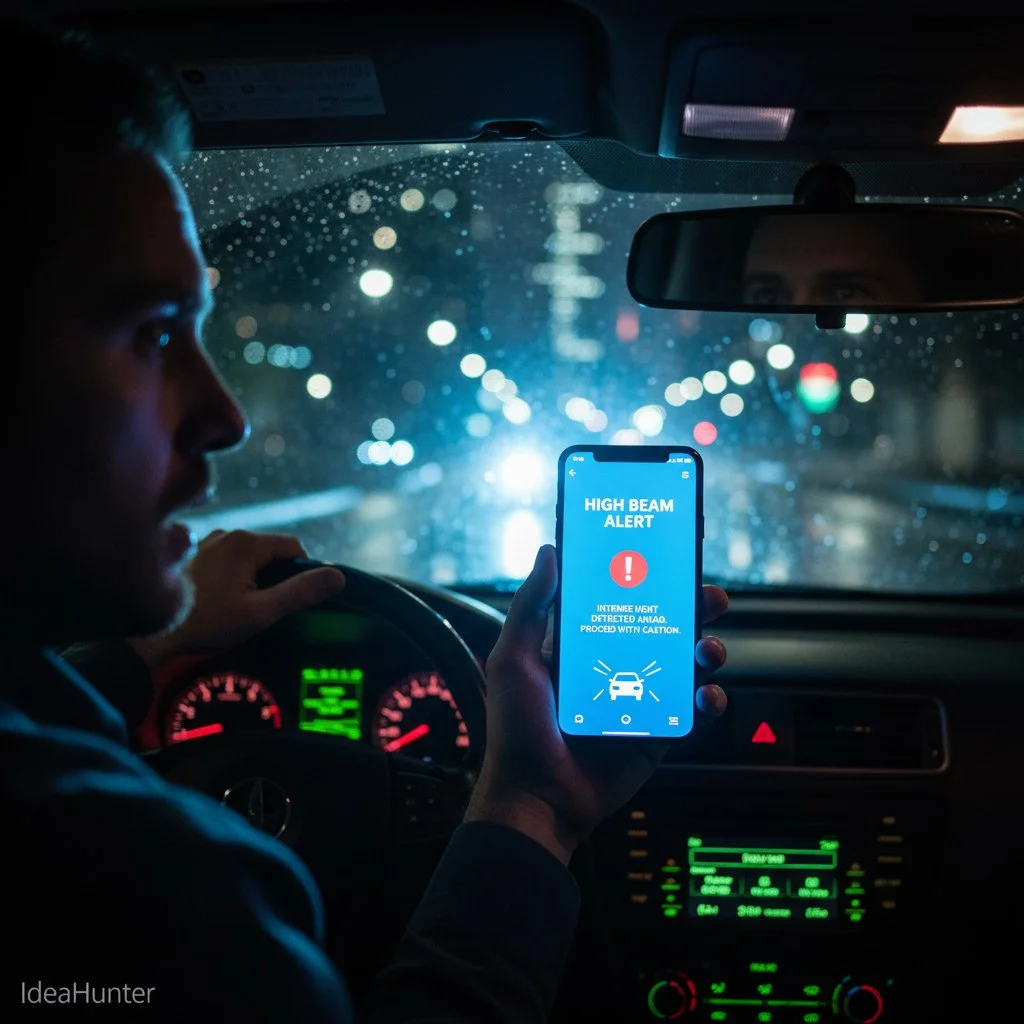
Validate BeamSafe Without Writing a Single Line of Code: The Weekend Concierge MVP Framework
TL;DR: Before you invest three months building an AI-powered app to detect blinding high beams, spend this weekend proving 3-5 drivers will pay you to solve their problem manually. Total investment: $0 and three days of actual work. This is how you separate real opportunities from upvote bait.
The Opportunity That Looks Too Good to Be True
A Reddit post in r/YouShouldKnow recently exploded with 7,071 upvotes. The complaint? Drivers who blind others with high beams or become invisible with only daytime running lights at night. The frustration was palpable. Thousands of people publicly validated this pain point.
IdeaHunter’s AI analysis flagged this opportunity with impressive metrics:
- Opportunity Score: 8.8/10
- Market Size: $500 million TAM
- Pain Level: 8/10 (high frustration, safety concerns)
- Feasibility Score: 8/10 (technically achievable)
- Competition Level: Low (no dedicated solutions exist)
The proposed solution—BeamSafe—would use computer vision AI to detect dangerous lighting situations in real-time, alerting drivers when they’re being blinded or when their own lights are misconfigured. The app would include:
- Real-time high beam detection via smartphone camera
- AI-powered computer vision for instant analysis
- Audio/visual alerts for dangerous situations
- Community reporting and heatmap visualization
- Gamification mechanics for viral growth
Sounds incredible, right? 7,000+ upvotes validating the problem, solid technical feasibility, clear differentiation from competitors like Waze. Time to start coding?
Absolutely not.
Upvotes don’t equal revenue. Reddit validation doesn’t prove willingness to pay. Market size estimates don’t guarantee customers. Before you write a single line of code, before you research computer vision libraries, before you design your viral growth mechanics—you need to answer one critical question:
Will anyone pay you to solve this problem?
Not “would they theoretically be interested.” Not “seems like a no-brainer.” Will they actually open their wallet this weekend?
There’s only one way to find out: deliver the solution manually.
Why the Concierge MVP Matters More Than You Think
The Concierge MVP—delivering your product’s value manually before automation—reveals truth that market research and Reddit upvotes can’t touch:
Truth #1: Willingness to Pay People say they want solutions all the time. They upvote problems. They comment “I need this!” But when you ask for $49, suddenly it’s “interesting but not right now.”
Manual delivery forces the payment conversation immediately. No “I’ll definitely buy it when it launches” promises. Money changes hands or it doesn’t.
Truth #2: Real Unit Economics That AI feature you think will take 2 weeks? The manual version might take 4 hours per customer to deliver properly. Now you know the true cost of your value proposition before building anything.
If you can’t deliver value profitably at small scale with manual labor, automation won’t magically fix broken economics.
Truth #3: What Customers Actually Value You think they want comprehensive reports with data visualizations. They actually just want validation that they’re not crazy for being frustrated. You think the killer feature is the AI detection. They actually care more about knowing which roads to avoid.
The manual version reveals what customers emphasize, what they’re willing to pay extra for, and what features you thought were critical that nobody mentions.
Truth #4: Operational Complexity If customer acquisition is brutal when you’re manually reaching out, your viral growth assumptions are fantasies. If delivery is straightforward but time-consuming, automation might actually work. If customers need constant hand-holding, your self-serve app idea needs rethinking.
Every hour you spend manually delivering the service teaches you something that would take months to learn through building and iterating an app.
The BeamSafe Concierge MVP: Your Weekend Framework
Forget the computer vision. Ignore the viral mechanics. Strip away everything that requires three months of development. What’s left is the core promise: helping drivers identify and respond to dangerous lighting situations.
Your weekend mission has three phases. Each one progressively harder and more revealing.
Friday Evening: Design Your $0 Service Prototype (6 hours)
Phase 1: Map the Manual Workflow (2 hours)
Write out exactly how you’ll deliver the “AI-powered detection” using your own eyes and brain. You’re essentially becoming a human AI for 5 customers.
Here’s one approach that mirrors the app’s intended functionality:
The Manual BeamSafe Assessment Service:
- Customer shares their regular night driving route and schedule
- You follow them (with permission) or ride as passenger on 2-3 night drives during their actual commute times
- You manually document every incident:
- High beam encounters (timestamp, location, duration)
- Invisible vehicles (DRL-only cars at night)
- Dangerous intersections or road segments
- Environmental factors (poorly lit areas, confusing signage)
- You create a personalized “Night Driving Safety Report” including:
- Route risk assessment with specific problem locations
- Frequency and timing of dangerous situations
- Specific recommendations for safer alternatives or defensive driving tactics
- Comparison to baseline risk levels
Is this scalable? Hell no. Does it prove people value the solution? Absolutely.
The key insight: you’re testing whether the outcome (safer night driving through awareness) has value, not whether the method (AI computer vision) is impressive.
Phase 2: Build a Landing Page That Sells Manual Service (3 hours)
Use Carrd ($19/year), Google Forms (free), or literally a Google Doc. Your offer needs to be specific and credible:
“Night Driving Safety Assessment - $49”
“I’ll personally analyze your commute for dangerous lighting situations—blinding high beams, invisible vehicles, high-risk intersections. You’ll receive a detailed report showing when and where you’re most at risk, plus specific recommendations for safer routes or defensive driving techniques.
Limited to 5 drivers this week. Assessment includes 2-3 ride-along sessions during your actual commute times.”
Your landing page structure:
- Hook: “Getting blinded by high beams 3+ times per commute? You’re not imagining it.”
- Problem: Expand on the exact Reddit frustrations—the safety risk, the lack of solutions, the helplessness
- Solution: Your manual assessment service (NOT an app, NOT automation)
- Social Proof: Link to the 7,071-upvote Reddit thread as validation
- Offer: $49, 5 spots only, delivery within 48 hours of assessment
- CTA: Simple contact method (email, phone, TypeForm with payment)
Critical elements to include:
- Specific deliverables (what they receive)
- Timeline (when they get results)
- Qualifications (why you’re credible—even if it’s just “I’ve experienced this 1,000 times myself”)
- Risk reversal (money-back guarantee if they don’t find value)
What to deliberately exclude:
- Any mention of AI, apps, or future automation
- Technical jargon that distracts from the outcome
- Promises you can’t deliver manually
- Features that sound impressive but don’t solve the core problem
You’re selling the outcome: “Know where you’re most at risk and how to drive safer at night.” The method is irrelevant at this stage.
Phase 3: Set Up Payment Collection (1 hour)
PayPal, Venmo, Stripe payment links. Whatever takes 10 minutes to configure. You need to know if people will actually pay, not if they’ll “definitely be interested when it launches.”
Create a simple payment flow:
- Customer fills out TypeForm with their commute details
- Automatic email with payment link
- Upon payment, confirmation email with scheduling link (Calendly works)
- 48-hour delivery guarantee from completed assessment
The payment happens before you deliver anything. This is crucial. Pre-payment is the only true validation.
Saturday: The Reality Check Nobody Wants (8-10 hours)
Your goal: Contact 20-30 potential customers. Close 3-5 paid deals by end of day.
This is where the fantasy of “7,071 upvotes = massive demand” meets reality. Upvoting is free and takes 0.2 seconds. Paying $49 and scheduling time for assessments requires actual commitment.
Where to find potential customers:
Reddit (obvious but oversaturated):
- Original r/YouShouldKnow thread comments
- r/driving, r/dashcam, r/IdiotsInCars discussions about lighting
- Search for “high beam” complaints in city/regional subreddits
Facebook Groups (better targeting):
- Local commuter groups
- Carpool coordination groups
- “New drivers” or “parents of teen drivers” groups
- Community safety groups
Nextdoor (highly targeted):
- Post in suburban neighborhoods where night driving is common
- Target areas with long commutes (check census data for average commute times)
- Engage in existing threads about road safety
YouTube Comments (engaged audience):
- Dash cam channels showing high beam incidents
- Road rage compilation videos
- Night driving tutorial videos
- Comments on videos about automotive lighting
Twitter/X (quick responses):
- Search for recent tweets containing “blinded by high beams”
- Reply with your offer
- Keep it conversational, not spammy
Your outreach template (adapt to each platform):
“Saw your post about high beam blindness. I’m doing personalized night driving safety assessments this week—basically I analyze your specific commute for dangerous lighting situations and give you a report showing when/where you’re most at risk. $49, only 5 spots available. Worth a quick chat?”
What to expect (brutal honesty):
- 10-15% response rate if your targeting is good
- 50% of responses will be “interesting but not right now”
- 30% will ghost after you mention payment
- 10% will ask questions that reveal they’re not serious buyers
- Maybe 10% will actually consider paying
This is where most founders quit. The idea felt so good when it had 7,071 upvotes. The opportunity score was 8.8/10. The market seemed massive. Now you’re getting ignored or told “$49 is too expensive for this.”
Good. You’re learning customer acquisition economics at zero development cost.
What to document obsessively:
- Messages sent vs. responses received
- Responses vs. serious conversations (they ask specific questions)
- Conversations vs. closed deals (payment received)
- Time spent per conversion
- Objections that came up repeatedly
- Demographics of people who responded vs. those who paid
If you close 3 deals at $49, you’ve made $147 and validated willingness-to-pay at that price point. More importantly, you’ve learned your true customer acquisition cost (time investment per customer).
If you close zero deals after contacting 30 well-targeted people, you’ve saved yourself three months of building something nobody wants enough to pay for.
Sunday: Deliver the Service and Calculate Reality (10-12 hours)
Honor your commitments. This is the hardest and most valuable part because you promised specific value for specific money.
For each customer who paid:
Step 1: Schedule and execute the assessment (3-4 hours per customer)
- Coordinate ride-along times that match their actual commute schedule
- Bring a notebook, phone for timestamps, and GPS tracking
- Document everything:
- High beam incidents (time, location, duration, impact severity)
- Invisible vehicle encounters (DRL-only cars)
- Problem intersections or road segments
- Environmental factors (street lighting quality, road surface conditions)
- Customer’s current defensive driving habits
Step 2: Create the deliverable (1-2 hours per customer)
A simple Google Doc report structured like this:
BeamSafe Manual Assessment Report
- Executive Summary: Overall risk assessment of their commute
- Incident Log: Detailed timeline of dangerous situations encountered
- High-Risk Locations: Map with specific problem areas highlighted
- Risk Frequency Analysis: How often they encounter each issue type
- Recommendations:
- Alternative routes that might be safer
- Time shifts that might reduce exposure
- Defensive driving tactics for unavoidable situations
- Equipment suggestions (night driving glasses, dash cam for documentation)
Step 3: Deliver and follow up (30 minutes per customer)
- Send report within 24 hours of assessment
- Schedule 15-minute call to walk through findings
- Ask for detailed feedback: what was valuable, what wasn’t, what surprised them
- Ask if they’d pay again for quarterly reassessments
- Ask if they’d recommend this to friends (and track if they actually do)
The Critical Calculations:
Track every hour you spend. This is your unit economics reality check.
Customer Acquisition Cost (CAC):
- Time spent on outreach ÷ customers closed
- Example: 8 hours messaging to close 3 customers = 2.67 hours per customer
- At $25/hour opportunity cost: CAC = $66.75
- You charged $49
- You’re losing $17.75 per customer on acquisition alone
Cost to Deliver:
- Time spent per customer assessment and report creation
- Example: 4 hours assessment + 1.5 hours report = 5.5 hours per customer
- At $25/hour: Cost to deliver = $137.50
- You charged $49
- You’re losing $88.50 per customer on delivery
Total Unit Economics:
- Revenue: $49
- CAC: $66.75
- Delivery cost: $137.50
- Loss per customer: -$155.25
Brutal, right? But critically important.
What this reveals:
If automation solves the delivery cost problem: The app would eliminate the 5.5 hours of manual work per customer. If you can acquire customers for $66.75 (still expensive) and deliver via app for near-zero marginal cost, the economics might work at scale.
If the customer acquisition cost is the real problem: Automation doesn’t fix this. Your viral growth mechanics need to work, or you need a completely different acquisition strategy. The app might work technically but fail commercially.
What to automate first: Whatever took the most time. Probably the manual observation and documentation. That’s exactly what the AI computer vision would handle in the real product. This validates that the automation should focus on the right problem.
Monday Morning: The Honest Assessment That Determines Everything
You survived the weekend. You’re exhausted. You maybe made $147 (if you closed 3 deals) but spent 25+ hours doing it. Time for brutal honesty.
Question 1: Did anyone pay?
If yes: You’ve validated willingness-to-pay at some price point. Maybe not $49, maybe not enough people yet, but someone valued this enough to exchange money for your manual solution. That’s rare and meaningful.
If no: The idea might be a “nice to have” frustration that doesn’t justify spending money to solve. Or your targeting was wrong. Or your offer wasn’t compelling. But after 30 contacts, zero payments suggests weak commercial viability.
Question 2: What did customers actually value?
Review your follow-up conversations. What did they emphasize when talking about your service?
Maybe they didn’t care about the detailed report—they just wanted validation that they’re not crazy for being frustrated. (This suggests your app should focus more on community validation features than individual analytics.)
Maybe they loved the specific route recommendations more than the incident documentation. (This suggests the core value is route optimization, not real-time detection.)
Maybe they wanted quarterly reassessments to track changes over time. (This suggests a subscription model might work better than one-time app download.)
Maybe they asked if you could do this for their teen driver. (This suggests the real customer might be parents, not commuters.)
Listen to what customers emphasize. Their actual behavior reveals their actual needs, which often differ from what they say in surveys or Reddit posts.
Question 3: What was harder than expected?
If customer acquisition was brutal: Your viral growth assumptions need serious questioning. If you couldn’t get 3 people to try a $49 service with no commitment, how will you get 10,000 people to download an app and engage with gamification mechanics?
If delivery was tedious but straightforward: Automation might genuinely solve the problem. The value is clear, the method just needs to scale.
If customers needed constant hand-holding: Your self-serve app idea might not match customer behavior. Some problems need high-touch solutions.
If customers didn’t actually implement recommendations: Awareness alone might not be enough. The app might need more active intervention features.
Question 4: What could you charge?
Based on the value delivered and customer reactions:
If customers got massive value: Could this be a $99 service? $199 for a comprehensive assessment with follow-up sessions? The manual version reveals true price sensitivity before you anchor yourself to a $2.99/month app pricing model.
If customers thought $49 was expensive: Would $29 work? What about a free basic assessment with $49 for the detailed report? The manual test lets you experiment with pricing models.
If customers asked about subscriptions: Would they pay $19/month for quarterly reassessments? This might be more viable than one-time app sales.
The Pivot Decision: What Your Weekend Revealed
Your concierge MVP probably proved one of three things:
Scenario 1: Strong Validation (Rare but Powerful)
- 3-5 paid customers closed from reasonable outreach volume
- Positive feedback, customers emphasizing specific value
- Clear automation path that dramatically improves unit economics
- Customers asking when the “app version” launches
- Evidence that acquisition could improve with better targeting
Decision: Build the MVP. You’ve validated demand, pricing, and value delivery. Invest in the automation that solves your delivery cost problem.
Next steps:
- Refine the core features based on what customers valued most
- Build a simple MVP focused on automating the manual observation process
- Keep the manual service running while you build (pre-orders for app access)
- Use your paying customers as beta testers for the automated version
Scenario 2: Weak Validation (Most Common)
- 1-2 sympathy purchases or heavily discounted sales
- Lukewarm feedback, customers didn’t find it as valuable as expected
- Unclear if automation solves the real problem
- High customer acquisition cost even with manual outreach
- Customers didn’t implement recommendations or ask about ongoing service
Decision: Iterate the service offering or abandon. Don’t build the app yet.
Next steps:
- Interview your customers deeply: what would have made this 10x more valuable?
- Test a different price point: maybe $29 gets you more learning
- Try a different customer segment: maybe parents of teen drivers respond better
- Consider a different delivery model: maybe it’s not an app, it’s a professional safety audit service
Scenario 3: No Validation (Most Valuable Outcome)
- Zero customers despite serious outreach effort (30+ quality contacts)
- No responses or all responses were “interesting but not for me”
- Price objections suggest willingness to pay doesn’t exist at any viable price point
- Delivery revealed the problem is less important than Reddit upvotes suggested
Decision: Kill it now. Be grateful you spent a weekend instead of six months.
What you learned:
- Upvotes don’t equal commercial viability
- The pain level might be real but not “pay to solve” level
- Your target customer assumptions were wrong
- The problem might need a different solution approach entirely
This is a win, not a failure. You validated your way out of a bad idea before wasting months of your life.
Why the BeamSafe Opportunity Still Has Merit (Despite Harsh Testing)
IdeaHunter’s database analysis identified genuine opportunity indicators:
Market Validation:
- 7,071 upvotes = documented pain point at scale
- Multiple subreddits and social platforms discussing this problem
- No dedicated solutions exist (competition level: Low)
- Adjacent products (Waze, Google Maps) don’t solve the core issue
Technical Feasibility:
- Computer vision libraries are mature (TensorFlow, OpenCV)
- Smartphone cameras are powerful enough for real-time detection
- Integration with navigation apps is straightforward
- Core technology challenge is achievable by solo developer
Business Model Potential:
- Freemium with premium heatmap features
- Potential for partnerships with automotive manufacturers
- Data monetization possibilities (anonymized danger zones)
- Subscription revenue from premium alerts
Differentiation:
- First-mover advantage in dedicated high beam detection
- Community-driven data improves accuracy over time
- Gamification creates viral potential
- Addresses safety concern that competitors ignore
But none of this matters if people won’t pay. The opportunity has merit on paper. Your weekend concierge test proves if it has merit in reality.
The Broader Lesson: Validation Before Development
The BeamSafe concierge framework applies to nearly every idea in IdeaHunter’s database:
Instead of building an AI productivity tool: Offer personalized productivity coaching for $200/week. See if anyone pays. Learn what they actually value.
Instead of building a marketplace app: Connect buyers and sellers manually via spreadsheet and email. Prove the transaction value before building the platform.
Instead of building a SaaS automation tool: Deliver the automation manually for the first 10 customers. Understand the workflow before codifying it.
The harsh truth: Most ideas should die in the concierge phase. That’s the point.
You’re filtering for the rare opportunities where manual delivery is so obviously valuable that automation becomes inevitable, not hopeful.
Your weekend validation cost you time and maybe $50 in landing page tools. The alternative? Three months building computer vision AI for an app nobody downloads. Six months perfecting viral mechanics that never go viral. A year of your life on something that dies with 47 total users.
Your Action Plan: Start This Friday
Friday (6 hours):
- Map your manual delivery workflow
- Build a landing page selling the manual service
- Set up payment collection
Saturday (8-10 hours):
- Contact 20-30 potential customers across multiple channels
- Close 3-5 paid deals (or learn why you can’t)
- Document everything: conversion rates, objections, time investment
Sunday (10-12 hours):
- Deliver the service to paying customers
- Create detailed reports/deliverables
- Collect feedback and track actual value delivered
- Calculate your true unit economics
Monday (2 hours):
- Honest assessment: strong validation, weak validation, or no validation?
- Decide: build the MVP, iterate the service, or kill the idea
- If building: define MVP scope based on what customers valued most
- If killing: start exploring next opportunity
Find Your Next Opportunity Worth Testing
The BeamSafe opportunity from IdeaHunter’s regularly updated database demonstrates the pattern:
- Strong social validation (7,071 upvotes)
- Clear pain point (safety concern, daily frustration)
- Technical feasibility (8/10 score)
- Low competition (no dedicated solutions)
But validation through Reddit upvotes isn’t enough. Validation through paying customers is everything.
Ready to find more opportunities worth testing with concierge MVPs?
Explore the full database of Reddit-validated business opportunities at IdeaHunter.ai—then spend your next weekend discovering if people will actually pay you to solve their problems.
Start your validation sprint this Friday. Find your first five customers. Or find out there aren’t five customers willing to pay.
The answer is worth more than six months of building something nobody wants.